

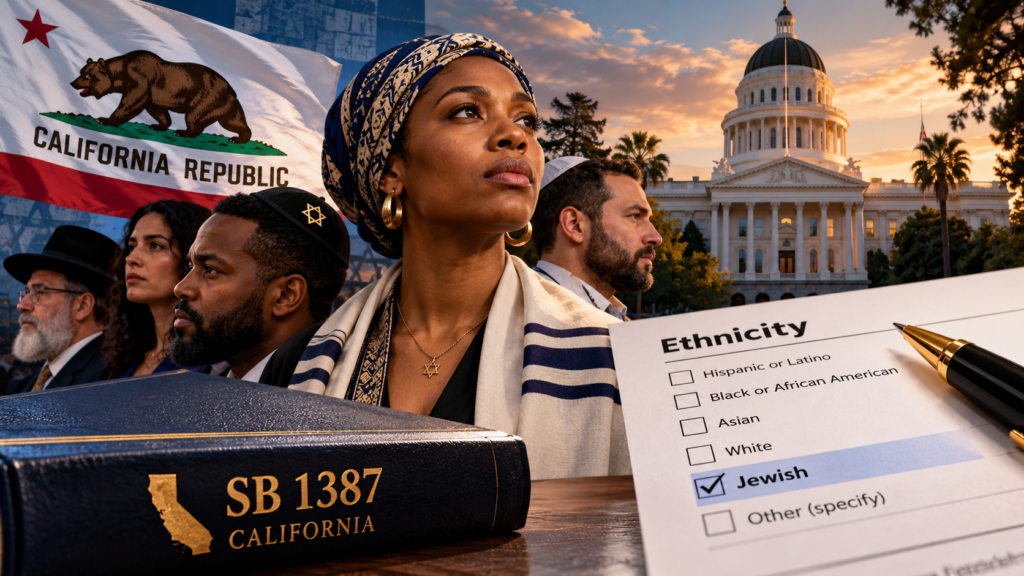
California lawmakers have approved legislation that could change how the state officially records Jewish identity—and the debate reaches far beyond another box on a government form.
Senate Bill 1387 would explicitly include Jewish identity within California’s statutory definition of ethnicity and require covered state agencies collecting ancestry or ethnic-origin information to provide a separate category for Jewish ancestry or ethnicity.
The legislation also adds “Jewish” to voluntary racial and ethnic self-identification collected by California’s prison system.
But SB 1387 has opened a much larger question:
Is Jewish identity a religion, an ethnicity, an ancestry, a people—or some combination of all four?
Supporters argue that reducing Jewish identity to religion leaves many Jews invisible in government data. They say Jewish identity can encompass ancestry, culture, family history and peoplehood, and that better demographic information could help California identify disparities and discrimination.
Some Jewish Californians strongly disagree.
Opponents have testified that Jewish communities include people with roots across Africa, the Middle East, Europe, Asia and elsewhere. They argue that placing those populations beneath a single ethnic designation could obscure the very diversity the legislation is intended to recognize.
There is also a more sensitive concern: government collection of Jewish identity.
SB 1387 contains significant safeguards. The legislation expressly prohibits using the information to create a registry of Jewish individuals and restricts disclosure of personally identifying information. Its broader demographic provisions rely on voluntary self-identification and allow people to identify with multiple categories.
That distinction is especially important for Black Jews.
Jewish and Black identities are not mutually exclusive, and the legislation does not require someone who identifies as both to choose one identity over the other where multiple selections are permitted.
The political support for SB 1387 has been substantial. But the deeper argument surrounding the legislation isn’t simply political.
It is about who defines identity.
Supporters see recognition. Critics see the danger of oversimplification. Supporters see data capable of exposing disparities. Critics question what happens when government formally categorizes a people whose identity crosses religion, ancestry, culture and ethnicity.
And that leaves California confronting a question much bigger than a checkbox:
When religion, ancestry, culture and history overlap, who gets to decide where one identity ends and another begins?
SB 1387 allows individuals to provide part of that answer through voluntary self-identification.
But California would be making a consequential decision of its own: putting into law that Jewish identity can be counted as ethnicity.
Sources: California SB 1387 enrolled text · California Legislature/Digital Democracy hearings · Jewish California